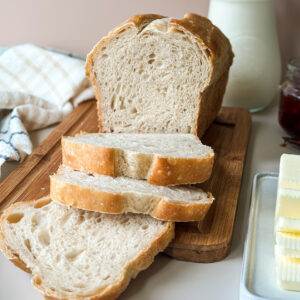
Easy Sourdough Sandwich Bread
This Easy Sourdough Sandwich Bread is a soft, fluffy, beginner friendly loaf with simple steps and a tender crumb with that classic sourdough flavor. Perfect for sandwiches, toast, or everyday baking.
Equipment
- Large bowl or straight edge container - You can use a bowl if you'd like, but I prefer to use a large square Tupperware with a straight edge so I can assess the rise of my dough easily. I use this Cambro 6 quart with a lid for up to 2 loaves at a time.
- digital kitchen scale - for accurate measuring as this recipe is in grams, especially helpful with sourdough baking. This kitchen scale is great to start with.
- Digital food thermometer (optional) - to check the temperature of your dough and bread, this ensures a more reliable result. I use this one linked here.
- Dough Spatula (optional) - to help release the dough and divide it. I love this silicone dough spatula for mixing linked here.
- Bench knife - to divide the dough for shaping.
- Bread Lame or sharp knife - to score the bread so it can expand properly. This bread lame is inexpensive and great as a starter tool.
- Loaf Pan - I always use these 1 lb sandwich loaf pans from USA Baking, they're reliable, don't stick, and give a golden finish to your bread.
- Cooling rack - to allow bread to cool.
- Bread knife - a quality bread knife is essential to even slices for your bread.
Ingredients
Feed Your Starter:
- 1 1/2 (20g) Tbspn mother starter
- 1/2 (100g) cup water
- 3/4 (100g) cup all-purpose flour
For the Bread:
- 1/3 (100g) cup active sourdough starter (fed and bubbly)
- 1 1/2 (360g) cups room temperature water (approx 75 degrees F)
- 2 (25g) Tbspns honey
- 1 1/2 (10g) tsp sea salt
- 4 (500g) cups bread flour or all-purpose
For Brushing on Top:
- 1 Tbsp salted butter cold
Instructions
Step 1: Feed Your Starter Night Before Baking
- Baker's Schedule: 8:00 PM
- To ensure a bubbly and active starter, feed your starter the night before baking.
- Use a 1:5:5 ratio to feed your starter (this means one part mature mother starter, five times the water, five times the flour).1 1/2 (20g) Tbspn mother starter, 1/2 (100g) cup water, 3/4 (100g) cup all-purpose flour
- Mix flour and water in a jar with a spatula, cover loosely with lid, and mark the volume of the starter in your jar with a rubber band or piece of tape and marker. Let starter sit at room temperature (70-75 degrees) overnight until bubbly and doubled in size.
Step 2: Make the Dough
- Baker's Schedule: Day 1- 8:00 AM
- In a large bowl or as I prefer a clear straight edge container, mix the active starter, water, and honey until the ingredients are combined.1/3 (100g) cup active sourdough starter , 1 1/2 (360g) cups room temperature water, 2 (25g) Tbspns honey
- Humidity Note: If you live in a hot and humid climate, adjust the water to reduce it by 25 grams to accommodate for the extra moisture in the environment.
- Add the salt and flour to the starter mixture. Stir and knead with your hand until all ingredients are combined into a shaggy dough. Cover with a damp towel or plastic and let it rest for 30 minutes at room temperature (70-77 degrees).1 1/2 (10g) tsp sea salt, 4 (500g) cups bread flour
Step 3: Strengthen the Dough (Stretch & Folds)
- Once the 30 minute rest has finished, you'll begin your stretch and folds. This helps build structure in your dough.
- Starting at the edge of the dough with lightly wet hands, gently lift one edge of the dough, stretch it up, and fold it over the center. Rotate the bowl or container 90 degrees and repeat with the next side. Do this for all four sides of the dough to form a ball.
- Cover the dough and let it rest for 30 minutes. Repeat this stretch-and-fold process two more times at 30-minute intervals for a total of 3 sets. Your dough should go from being rough and clumpy to smooth and silky.
- Note on Temperature: Your dough loves a warmer climate, so aim to keep your dough between 73-78 degrees (you can use your digital thermometer to check the temperature). If you need to warm it up, try putting it in the oven with a light on, near a heater, or even on top of a dryer that's on to conduct some heat!
Step 4: Bulk Fermentation
- Assessing Rise Tip: After your dough is incorporated, try to gently push the dough down to be level in the bowl or container after the stretch and folds. Mark roughly where your dough is hitting on the side of the container with a sharpie or dry erase marker (you can put a piece of tape over if you don't want to mark your bowl or jar).
- After you mark the volume, make another mark above the that where the dough would be if it rose roughly 90 percent. This will be your target for how much you want your dough to rise during bulk fermentation. This dough is very easy to overproof, so I strongly suggest a guide and to shape it right BEFORE it reaches a 90 percent rise.
- Cover the dough and allow it to rest in a warm spot until it has reached a 90 percent rise.
Step 5: Shaping the Dough
- Lightly spray a clean work surface with cooking spray or dust with flour, then gently turn out your dough. I prefer cooking spray here; it makes shaping easier and helps prevent sticking.
- To shape the sandwich loaf: Gently stretch one portion about 8 inches wide and 9 inches long.
- Starting with one of the (9 inch) sides, fold the dough into thirds over itself, like a letter. Repeat this step on the other side. You should now have a rectangle about 9 inches long and 5 inches wide.
- Starting at the bottom, roll the dough up gently to form a log shape. Pinch the seam and ends to seal.
- Transfer your loaf to the oiled pan, seam side down. Cover loosely with plastic or a damp towel to proof.
Step 6: Final Proofing
- Allow the sandwich loaf to proof roughly an hour at room temperature covered, the dough should rise about 1/2 inch over the edge of the pan. Don't skip this rise, it's key to a light and airy loaf!
- Overnight Fermentation Option: If you want to refrigerate your loaf overnight, simply cover the dough filled pan with plastic (I use a disposable shower cap) and transfer to the refrigerator overnight. You WILL NOT proof the dough in the pan until the next day.
- When you're ready to bake the loaf the next day, follow the directions to proof the dough over the edge of the pan before baking. Please note that this make take longer as the dough is colder, and that the loaf may brown more on the edges due to condensation.
Step 7: Baking the Bread
- Preheat your oven to 400 F. Make sure your oven is full preheated before baking your bread.
- Transfer your bread to the oven, and set the timer for ten minutes.
- After ten minutes, remove the bread pan and cut a single deep score down the center of the loaf. This score helps with expansion and makes sure the bread can rise properly.
- Return the bread quickly back to the hot oven (400 F), and set the timer for another 20 minutes. After 20 minutes of baking, rotate the pan to avoid the edges over browning.
- Bake the bread for another 20 minutes after this at 400 F, for a total of 50 minutes. Your bread internal temperature should read between 200-205 F, you can check this by inserting a digital thermometer into the side of the bread (Don't worry, it won't hurt it!).
- If your bread is starting to burn or get too brown on the top and hasn't finished baking, tent with foil and finish baking to avoid the top being burned. All ovens are different so watch for this!
- Remove the bread from the oven as soon as it's finished baking, and let it rest in the pan a minute or two. Once slightly cooled, remove the bread from the pan and transfer the loaf to a wire cooling rack to completely cool and to prevent soggy crusts.
- If you want an extra golden crust and shine, you can brush the top of the loaf with melted butter but this is optional.1 Tbsp salted butter
- Allow bread to fully cool before slicing and serving!
- Yields 1 sandwich loaf
Notes
How to Store:
Room Temperature- Allow bread to cool completely before storing. Transfer to a sealed bag of your choice with the air removed. This sandwich bread will stay fresh at room temperature for 4-5 days before molding. For best results, slice and freeze by day 3-4 to extend freshness. Freezer- Store sliced bread in a freezer-safe bag with as much air removed as possible. For easier separation, place pieces of parchment between the slices before freezing. Thaw at room temperature and toast directly for best flavor and texture.Nutrition
Serving: 1sliceCalories: 156kcalCarbohydrates: 32gProtein: 4.5gFat: 0.5gFiber: 1g
Tried this recipe?Let us know how it was!