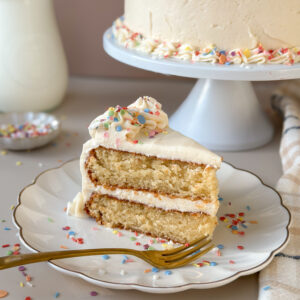
Sourdough Vanilla Cake (moist and fluffy!)
Everyone deserves a homemade birthday cake, and this Sourdough Vanilla Cake (moist and fluffy!) is the kind of go-to recipe you'll come back to whenever you want something classic, cozy, and made from scratch. It's soft, tall, and plush - finished with a rich vanilla bean buttercream frosting for that perfect bite. It's the only vanilla cake recipe you'll need for birthdays, celebrations, or just because you want a sweet little moment in the middle of your week.
Equipment
- Mixing bowls (large and medium) - for mixing batter and frosting. You can also use your stand mixer bowl for the frosting if you wish.
- Whisk - for combining ingredients.
- Kitchen scale (optional) - for accurate measuring, especially helpful with sourdough baking linked here.
- Measuring cups and spoons - if not using a scale and for smaller ingredients.
- Cake pans - two 9-inch round pans or one 9x13-inch pan (I love these 9 inch cake pans linked here with anodized steel for even baking and a perfect exterior).
- Parchment paper - (optional) for lining pans. This really helps the cake release cleanly from the pan. Cut a circle to fit the bottom.
- Hand beaters or stand mixer - to whip frosting.
- Cooling rack - for cooling cakes.
- Toothpick or cake tester - to test when cake is done.
- Offset spatula - for spreading frosting on cake.
- Fine-mesh sieve or sifter - for powdered sugar to avoid grainy frosting.
- Pastry bags and decorating tips (optional) - for adding decorations to the cake. If you're new to cake decoration, this set linked here has pastry bags and an assortment of classic tips to choose from
- Cake stand or platter - for serving cake.
Ingredients
Wet Ingredients:
- 1/2 (120g) cup sourdough discard 100% hydration
- 1 ½ (300g) cups granulated sugar
- 1 (240g) cup milk or buttermilk
- ¾ (190g) cup neutral oil
- 2 large eggs room temperature
- 1 Tbsp vanilla extract
Dry Ingredients:
- 1 ¾ (225g) cups all-purpose flour
- 1 Tbspn baking powder
- ¾ tsp salt
- ¼ tsp baking soda
Vanilla Buttercream:
- 1½ (339g) cups unsalted butter room temperature
- 5¼ (630g) cups powdered sugar sifted
- ¼ tsp fine sea salt
- 1½ Tbsp vanilla extract
- 1/4 (60g) cup heavy cream cold
Instructions
Step 1: Mix The Base
- In a bowl, combine with a whisk loosely the flour, sourdough discard, white sugar, buttermilk or milk, avocado oil (or neutral oil), and the vanilla. It's okay if a few small lumps remain, you don't want to overmix this base.1/2 (120g) cup sourdough discard, 1 ½ (300g) cups granulated sugar, 1 (240g) cup milk or buttermilk, ¾ (190g) cup neutral oil, 1 ¾ (225g) cups all-purpose flour, 1 Tbsp vanilla extract
- Optional Overnight Fermentation: Cover the bowl with plastic wrap, and refrigerate overnight. This step is key in your fermentation process. If you want to shorten your fermentation time, you can allow the batter to rest for 4 hours at room temperature for a same day bake. I don't advise leaving this batter at room temperature overnight, its too hydrated and will overproof.
Step 2: Finish Mixing Batter
- If you fermented the batter overnight in the refrigerator, allow the bowl of batter to rest on the counter for roughly 1 hour. This is a key step to achieving a tender crumb, don't skip this step! If you like temperature cues, the temperature of the batter should read roughly 70 F before proceeding.
- If you allowed batter to rest on the counter and did not refrigerate or you're doing a quick bake, skip this step of resting.
- Once the batter has reached room temperature, add the eggs, baking powder, baking soda, and salt to the bowl.2 large eggs, 1 Tbspn baking powder, ¾ tsp salt, ¼ tsp baking soda
- Whisk gently the remaining ingredients into the batter just until combined and smooth, avoiding overmixing to make sure your cake crumb doesn't get tough.
Step 3: Bake Cakes
- Preheat the oven to 350°F (175°C). Grease and lightly flour two 9-inch pans or one 9x13 baking pan. I strongly recommend lining the very bottom of the pan with parchment paper at this time, this helps the cake release evenly.
- Baker's Tip: If you aren't sure how to line the bottom of your cake pan with parchment, simply place your cake pan on a sheet of parchment and draw along the edge to form the shape you need. Cut and place at the bottom of your pan.
- If you're using 2 9-inch cake pans, divide batter evenly between the two pans. This should roughly be 2 1/4 cups (500g) batter per 9-inch pan. If using a sheet pan, pour all of the batter into the pan. Tap the pans lightly on a hard surface to release any air bubbles before baking.
- Set your timer for 30 minutes. Check the cake at 30 minutes, inserting a toothpick to check doneness. This cake takes me anywhere between 30-35 minutes to be done. When the cake is done, a toothpick should come out with a few moist crumbs but not with wet batter. When you touch the top of the center of the cake, it should be firm and not overly glossy. Internal temperature should be between 200-205 F in the center.
- Note: If vanilla cake is under done, when cake is removed from heat the center will fall. If you overbake the cake, it will err on the side of being dry. Go slow and check frequently after the 30 minute mark to ensure the cake is baked properly without losing moisture. Use the notes above to make sure cake is baked correctly.
- When cakes are done, cool slightly in pans then turn out onto racks. Allow to cool completely. If desired, trim any uneven tops and wrap in plastic. Freeze cake while you prepare your frosting.
Step 4: Make the Vanilla Buttercream
- In a stand mixer or a large bowl, add your butter. Cream on high for 3-4 minutes until pale and fluffy.1½ (339g) cups unsalted butter
- Add sifted powdered sugar and salt to the frosting, and beat on low to incorporate. Once the sugar and salt are mixed in, whip the frosting on high for a minute or two until the frosting is smooth. At this point the icing may look very stiff. Don't worry!5¼ (630g) cups powdered sugar, ¼ tsp fine sea salt
- Add vanilla and half of the cream to the icing. Whip on high until the frosting starts to become light and fluffy. Add the remaining cream in 1 Tablespoon intervals until the frosting has achieved your desired consistency.1/4 (60g) cup heavy cream, 1½ Tbsp vanilla extract
Step 5: Frost the Cake
- For a two-tier cake: If frosting a two-tier cake remove cakes from the freezer, and place 1 cake upside down on cake stand. I like to put a dollop of icing on the cake stand first to help the cake stick to the stand. Use half of the vanilla buttercream to frost the 1st layer of cake.
- When first layer of cake is smoothly covered in frosting, place the second layer upside down on top of the first. Use remaining frosting to cover the top and sides of the second layer, leaving some left over frosting if you want to pipe any decorative details. I piped small swirls around the top of my cake and added a shell border, then sprinkled dye-free celebration sprinkles over the edges for a festive touch.
- For a single sheet cake: turn cake upside down onto serving platter. Spread frosting over the top and sides of the entire cake, smoothing with a spatula. Decorate cake if desired with left over frosting and sprinkles.
- Slice cake and serve!
- Yields 2 9 inch cakes or 1 9x13 cake
Notes
How to Store:
Room Temperature- store at room temperature in airtight container or stand with lid for up to 3 days. Refrigerator- store in airtight container for up to 5 days. Bring to room temperature before serving. Freezer- Wrap unfrosted cakes tightly in plastic, freeze up to 2 months. Thaw overnight in refrigerator when ready to use. Frost and serve cake. Tried this recipe?Let us know how it was!