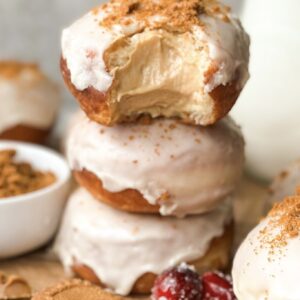
Sourdough Cookie Butter Donuts
These Sourdough Cookie Butter Donuts are fluffy sourdough donuts filled with a silky cookie butter cream and dipped in a thick maple glaze sprinkled with more Biscoff® cookies. A cozy, bakery-quality holiday donut you’ll want to make every weekend during the holidays.
Ingredients
Sweet Levain:
- 2 (25g) Tbsp sourdough starter (100% hydration)
- 1/3 (100g) cup water
- 3/4 (100g) cup all-purpose flour
- 2 (25g) Tbsp white sugar
Tangzhong:
- 2 (20g) Tbsp all-purpose flour
- 1/3 (100g) cup whole milk
Dough:
- 1 (225g) cup whole milk
- 1 (200g) cup sweet levain
- 1 (50g) egg
- 1 egg yolk
- 1/3 (75g) cup white granulated sugar
- 1 tsp vanilla extract
- All of the tangzhong
- 4 1/2 (500g-530g) cups all-purpose flour or bread flour
- 1 (10g) tsp sea salt
- 6 (85g) tbsp unsalted butter, softened
Cookie Butter Filling:
- 1 (226g) cup unsalted butter softened
- ¾ (180g) cup cookie butter
- 2 ½ (300g) cups powdered sugar
- 1 tsp vanilla
- ¼ tsp sea salt
- 1 tsp cornstarch optional for extra firmness
- 4 (60g) Tbsp heavy cream
Maple Glaze:
- 3 ½ (420g) cups powdered sugar
- 2 (30g) tbsp unsalted butter melted
- ½ tsp vanilla extract
- 1 tsp maple extract
- 3 (63g) tbsp pure maple syrup
- 4 (60g) tbsp heavy cream
- 3 (45g) tbsp milk
- ¼ tsp fine salt
Garnish:
- 1/2 (60g) Biscoff® cookies crushed
For Frying Donuts:
- 3-4 cups organic coconut oil or neutral oil
Instructions
Step 1: Make the Sweet Levain (Night Before)
- Baker's Schedule: 8:00 PM- Night Before
- In a clean jar, mix your mother starter with the flour, water, and sugar. Give it a good stir, and allow it to rest at room temperature (optimally 73-75 degrees F). I like to mark the volume in my jar with a rubber band so it's easy to asses the rise the next morning. When the sweet levain has doubled in size, it's time to mix your donut dough.2 (25g) Tbsp sourdough starter (100% hydration), 1/3 (100g) cup water, 3/4 (100g) cup all-purpose flour, 2 (25g) Tbsp white sugar
Step 2: Make the Tangzhong
- Baker's Schedule: 8:00 AM- Day 1
- Before you get started on mixing your dough, you'll make your tangzhong. Whisk milk and flour together in a small saucepan.2 (20g) Tbsp all-purpose flour, 1/3 (100g) cup whole milk
- Cook the tangzhong over medium/low heat, stirring constantly, until it thickens into a paste that is similar to pudding (about 2–3 minutes). For precision, use your digital thermometer and heat to 148-155 F. Do not overheat, or your mixture will be too thick.
- Scrape into a bowl immediately to prevent further cooking, cover, and let cool to room temperature before adding to your dough.
- Prepare your dough while tangzhong cools.
Step 3: Mix the Dough
- Baker's Schedule: 8:30 AM- Day 1
- In a stand mixer fitted with a dough hook or large mixing bowl, add the whole milk, sweet levain, egg and egg yolk, sugar, vanilla, and all of the tangzhong. Whisk ingredients together quickly, it's okay if it's lumpy.1 (225g) cup whole milk, 1 (200g) cup sweet levain, 1 (50g) egg, 1 egg yolk, 1/3 (75g) cup white granulated sugar , 1 tsp vanilla extract, All of the tangzhong
- Add your flour and salt into your wet ingredients.4 1/2 (500g-530g) cups all-purpose flour, 1 (10g) tsp sea salt
- Mix on low until a shaggy dough forms, about 2-3 minutes. Scrape down bowl if needed. If using your hands, knead until you work dough together. This is a higher hydration dough, so be aware it will be sticky.
- Once the dough has come together add softened butter, a tablespoon at a time mixing each tablespoon in until adding the next. Use a dough scraper to scrape the edges of the bowl to make sure everything is getting mixed in.6 (85g) tbsp unsalted butter, softened
- Continue mixing on medium-low (speed 2–3) for 8–10 minutes, until dough is smooth, elastic, and tacky but not sticky. If mixing by hand knead dough until butter has fully incorporated and dough is smooth and tacky.
- Mixing Notes: If kneading in a mixer or if dough is very wet when mixing by hand, add an additional 25 grams (3 Tablespoons) of flour and mix into dough. Make sure to work flour in completely and assess if you need more flour. I did this twice adding in a total of 50 grams (6 Tablespoons) of flour for the dough consistency I liked.
- Do not add more than 50 grams of flour at this stage, or you will lose the high hydration of the dough and end up with a dense donut. If using a stand mixer, dough can become more warm and sticky and I have found kneading dough with my hand (perform a set of stretch and folds) for a minute after mixing in my stand mixer really helps bring the dough together.
Step 4: Bulk Fermentation
- Spray a clean bowl with oil. Shape the dough into a smooth ball and place it in the bowl. Cover with plastic wrap.
- If you used a stand mixer, perform one set of stretch and folds after 30 minutes to strengthen your dough. If you mixed dough by hand, perform 3 sets of stretch and folds at 30 minute intervals at the beginning of bulk fermentation. After stretch and folds are completed, cover dough and allow to continue proofing.
- Let dough rise at 75–80°F until doubled in size, this takes about 5–6 hours. If your house is very cold, you can put dough in the oven with the light on for a warmer atmosphere. This proofing time is a general guide, this process may take longer the key is to assess when the dough has nearly doubled that's when it's ready.
- Overnight Fermentation: Once dough has finished rising, you can cover and transfer to the refrigerator overnight for a longer ferment or you can skip this step and go straight to making your donuts. I do find it to be easier to shape the donuts when the dough has been refrigerated but it isn't necessary.
Step 5: Shape the Donuts
- If you refrigerated the dough overnight, remove from the refrigerator and allow to rest at room temperature for about 30 minutes to take the chill off.
- When dough is ready, flour a surface well and dump the dough onto the work area. Flour the top of the dough and the rolling pin as well, and gently roll out the dough to a circle that is about 1/2 inch thickness (it doesn't have to be a perfect circle just roll out the dough).
- Flour the cookie cutter or the cup, and cut out 12 even circles of dough. I don't recommend gathering this dough and rolling it to make more donuts, I find that the initial time you roll out and cut the shapes it has the best texture so keep that in mind. The scraps would make excellent donut holes though!
- Transfer the donuts to 4x4 pre-cut parchment squares that are lightly floured, and lay them to proof on 2 baking sheets.
- Cover your pans with plastic wrap and allow fritters to proof at room temperature roughly 1 1/2 to 2 hours. They should be puffy and jiggly when they're done proofing. This step is key to a light donut, so make sure you don't skip it!
Step 6: Make the Cookie Butter Filling
- While the donuts proof, prepare your cookie butter filling. In a stand mixer bowl or a large mixing bowl, add the softened butter and the cookie butter (make sure this is room temperature).
- Whip the butter and cookie butter together for 3-4 minutes on high until light and smooth.1 (226g) cup unsalted butter, ¾ (180g) cup cookie butter
- Add the powdered sugar and cornstarch to the filling, and mix on low for a minute until dry ingredients are mixed in. Once sugar is incorporated, beat on high until the filling is light and creamy.2 ½ (300g) cups powdered sugar, 1 tsp cornstarch
- Add the vanilla, cream, and salt to the filling and beat into the filling on high for a minute or two more until everything is well combined and the filling is airy and fluffy.1 tsp vanilla, 4 (60g) Tbsp heavy cream, ¼ tsp sea salt
- Fit the pastry bag with a piping tip, and transfer the cookie butter filling to the prepared pastry bag. You can place this in the refrigerator while you fry the donuts to make sure it doesn't get too soft, but don't leave it in the cold for longer than 30 minutes or the filling will be too stiff to pipe.
- Place cookies for topping in a plastic bag, and crush with a rolling pin for the garnish. Transfer to a shallow dish for later.
Step 7: Fry the Donuts
- Line a cooling rack with paper towels. Fit your candy thermometer into your deep pot. Transfer 3–4 cups of organic coconut oil to a deep pot or Dutch oven, and heat to 350-360°F on medium heat. If oil gets hotter than this, reduce heat accordingly. Watch your temperatures very closely and adjust your heat as needed to avoid burning the donuts.3-4 cups organic coconut oil
- When oil is ready, transfer 2-3 donuts with parchment paper into oil (you can remove paper with tongs when it separates).
- Fry 30 seconds at a time per side, flipping fritters gently using chopsticks or a slotted spoon. I repeat this step a few times rotating donuts to avoid burning. Remove after 2-3 minutes with a slotted spoon or spider spoon and donuts are a golden brown. Transfer donuts to a rack lined with paper towels to cool.
Step 8: Make the Maple Glaze
- Melt the butter for your glaze in a medium sized pot over low heat.2 (30g) tbsp unsalted butter
- When the butter has melted, add the powdered sugar, maple syrup, and cream. Whisk until the powdered sugar has completely dissolved, making sure to keep this on LOW heat.3 ½ (420g) cups powdered sugar, 3 (63g) tbsp pure maple syrup, 4 (60g) tbsp heavy cream
- Remove from heat immediately after sugar has dissolved, and whisk in the vanilla, maple extract and salt.½ tsp vanilla extract, 1 tsp maple extract, ¼ tsp fine salt
- If the glaze is too thick, thin with a couple tablespoons of milk at a time until it reaches the desired thickness. Be aware that if you overheat the glaze, it will be more thin. I try to heat it just to the point that it needs just a minute to cool and then I can comfortably dip the donuts with my hand in the glaze.3 (45g) tbsp milk
Step 9: Fill and Glaze the Donuts
- Gather your piping bag filled with the cookie butter and a skewer or chopstick.
- Make sure the donuts have cooled first before you proceed with filling them! Poke a hole into the top of one of the donuts with a skewer to make a hole to fill the donut. Place the piping tip into the donut, and pipe the cookie butter cream into the donut. Repeat this step until all of the donuts have been filled.
- Dip filled donuts face-down into glaze and cover half the donut. Remove from glaze and let excess drip off, then transfer back to an unlined wire rack face up to let the glaze set. Top the donuts with the crushed cookie crumbles for extra crunch and goodness. Let glaze set for 15 minutes before serving.1/2 (60g) Biscoff® cookies
- Yields 12 donuts
Notes
How to Store:
Room Temperature- Keep donuts in an airtight container at room temp up to 2 days. But in my opinion, these are best enjoyed fresh! Tried this recipe?Let us know how it was!